espresso-shots
Espresso Shots 11-1-26

It's that time again for my weekly update, which includes a short collection of noteworthy finds, posts that inspire, as well as a few reflections from the past week or two. I'll aim to land these in your inbox by the weekend, in time to pair with your morning coffee (or your preferred cup of inspiration).
The Latest Drippings ☕️
- Patrick Stewart, 'Star Trek' Captain and 'X-Men' Superhero, Dies at 86. This was the gut-punch of the week for me; Sir Patrick Stewart passed away this past Wednesday after 'a brief journey with Alzheimer's and Lewy body dementia'. His family has asked fans to support Alzheimer's research and dementia caregivers instead of sending flowers. There was something always kind and deeply human in his performances, especially as Jean-Luc Picard, and from everything I've read, that wasn't acting. He spent his life using his fame to show up for other people, and I can't think of a better reminder of what it looks like to be a good human. There's no shortage of tributes that have been written online about his passing; in those I learned he had published a memoir a few years back, Making It So, which I've begun to read. One line has already stuck with me: 'You will never achieve success... Oh God, no. ... by insuring against failure.' Make it so.
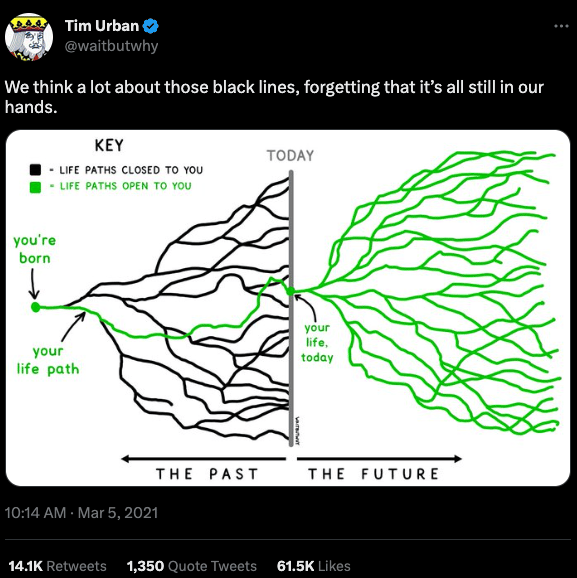
- The Person We Expected to Become. Psychologists call it a lost possible self: 'an imagined version of ourselves, once valued or expected, that we now understand as no longer available. Its loss concerns both a hoped-for future and the identity we associated with that future.' While the past can be a place to draw value and knowledge from, I would triple down on the advice from this post: 'recognize choices made previously were based on the resources and perspectives available at that time.' It's good to reflect on the past, without living inside of it. I've always loved this visual from Tim Urban:
- Your Gear Is Never Just a Tool. 'But there’s more to the objects we carry than that. Anyone who has hung onto a beaten-up pack long after a better one arrived knows it. So does anyone who has pulled on their favorite jacket and felt a little taller, a little more confident.' I really enjoyed this post on the three levels of reaction we have to things (how a thing feels, how it works, what it means). It resonates with why I spend so much time crafting out my desk (which needs an update to the 2026 vibe) or everyday carry and is similar to last week's fondness for the iPod: 'Every time you fire it up, you begin to salivate because it's fun to use. Apple understands that the most important part of designing a user interface is that its job is to create an emotional response with software by creating an experience around it.' Don Norman's Emotional Design is now on the to-read list as well.
- A Typography Geek Pointed Out Something About the Space Shuttle Discovery and Now I Can't Unsee It. Fun fact of the week: Apparently, the 's' on the Space Shuttle Discovery is upside down. Given it flew 39 missions over roughly 150 million miles that way for 27 years, it's amazing that no one had pointed that out before (or, at least, that I could find).
- Lumina: An Unprecedented Look at Universe's First 2 Billion Years. This is a super cool Harvard–Smithsonian simulation that explores what happened right after the Big Bang through the next 2 billion years of cosmic evolution. As Carl Sagan put it, 'we are made of star stuff.'
- The Baloney Detection Kit: Carl Sagan's Timeless Tenets of Critical Thinking. Carl Sagan's Baloney Detection Kit (and PDF) is one of my favorites that I learned about in 2024, and it seems like required reading for 2026. The kit is known as 'an informal set of thinking tools and techniques for evaluating arguments and detecting falsehoods', and this post explores it as a tool to help with 'unlearning and avoiding the most common pitfalls of common sense.' 'In addition to teaching us what to do when evaluating a claim to knowledge, any good baloney detection kit must also teach us what not to do. It helps us recognize the most common and perilous fallacies of logic and rhetoric. Many good examples can be found in religion and politics, because their practitioners are so often obliged to justify two contradictory propositions.' I've mentioned critical thinking as an important skill to continuously work at, and the kit is a solid way to do just that.
- Why a World Without Friction Is a World Without Progress. Some weeks it feels like all I've been focusing on is friction reduction: figuring out what the blockers are, and how to optimize time or systems. 'When people speak of a frictionless world, they imagine ease. But ease without resistance is a wheel spinning in place, motion without progress.' The point is, of course, that friction is necessary in certain situations, and it is also important to seek good friction: 'Obstacles can disable you. Obstacles can enable you.'
- How AI Killed My Software Career. This video echoes the sentiment I've been hearing (and writing about) as of late regarding the state of software engineering in 2026. Two bits that spoke to me: 1) 'It makes your life easy, but what I realize more and more is I don’t really want my life to be easy. I want it to be better.' and 2) 'I'm really not worried of falling behind in a game that I actually don’t even want to be playing.' I don't know where this AI stuff is going, but I've been circling around this idea: Programming may be dead, but engineering is needed more than ever. Leveraging AI as a way to re-wild my creativity and curiosity with building things has been incredibly fun.
- On the Death of Amazon's Writing Culture. I can't remember who to attribute 'writing is thinking' to, but it's interesting to see what's happening inside certain organizational cultures when they are leaning too heavily into letting AI do the work. Daniel Miessler's Writing Is Closer to Thought Than Code counters with 'I think the most important thing in any project you’re building with AI (and even without it), from building a web app, to starting a business, to managing a federation of planets, is how completely and accurately you articulate exactly what you want.' The bug is in the prose. Perhaps both are true — different sides of the same coin. It will certainly be interesting to see how this all plays out over the next year or so. (Em dash used by me, a human.)
- Bad at Email. I need to look at email less. A core part of my flow was based on Inbox Zero. But something around that philosophy has changed over the last several years, and now it's just another mindless grab at my attention. Funny question, though: did you get this newsletter ... in your inbox? 🤔
- My First Visit to New York Cities. Happy Halloween! The creepiest thing I learned about this week was a 1984 8-bit 'spiritual predecessor' to Grand Theft Auto. 'Your job was to drive and walk around New York City. If you crashed into another car, your car would be towed. If you ran out of fuel, you had to use the subway – or go on foot. If you then fell under another car, you ended up in a hospital.' But here's the interesting bit regarding a bug the coders left in: if you drove into the city, stopped the car, and let it idle, you'd run out of gas in about 13 minutes. You were ejected from the car and forced to walk, but you could walk OUT of the city. 'And what is going on to the left is truly frightening. The road ends and you encounter another city... a nightmare city of sorts, with cars changing shapes, driving into the buildings, and crashing into each other. Get run over by one of these mangled cars, and things get worse – you travel forever over a surreal 8-bit nightmare world, with random disconnected streets, to a land in the middle of nowhere. It’s a creepy mirror world, an endless universe filled with broken cities where the rules of time and space don’t apply, landscapes echoing with sounds of car collisions that never seem to cease.' Check out the post if you want to get instructions on how to try this yourself in an in-browser emulator.
- The End of the Internet. It's been a wild 'Black October', as coined by the infosec community, and many are wondering what happens next with an open Internet that's been 'replaced by a landscape defined by security vulnerabilities, aggressive AI, and declining trust.' I do like Ben's premise that, for creators, 'sustainability lies in becoming smaller, focusing on niche audiences and private, high-trust associations.' On a side note, my interest in cybersecurity and hacking, which fueled a lot of my own early curiosity about how things worked, started with reading Clifford Stoll's 1989 book, The Cuckoo's Egg.
- The Kitchen Is Only the Cool Spot Because You're in It. Wanted to close out this week with this post, which resonated with how I've been viewing life lately. 'The living room was the familiar place to sit and chat with people you already knew: it was a great way to spend time with friends. The kitchen was the crowded space to talk and meet new, weird, interesting people: it was the social network lubricant. Both rooms managed to coexist, and in many ways were codependent.' It's important to remember: places are people.
Amor Fati ✌🏻