
What Deserves My Attention Now
"So why would you want to go there? -Because I never have. That's why people go places, isn't it?" - Truman Burbank (Jim Carrey) in The Truman Show

Clearing the path for curiosity in 2026
Over the last 10 years, I have published an annual "things I like" end-of-year wrap-up. It's a big-ass post to explore all the apps/processes/mental trauma/musings/etc that I have found helpful throughout the year. If you'd like to read the previous years' ramblings, here are: 2024, 2023|2022|2021|2020|2019, etc.
When it came time to write up 2025, honestly - I wasn't feeling it. There's plenty of great write-ups out there already - what's one more voice echoing the wacko upside-down state of the world right now?
So - taking a different path this year. We'll see where it goes. :)
But first, just a quick thank you. Your support is always appreciated! My ramblings newsletter is going on its 6th year, and what was set up as a way to keep a few peers, friends, and colleagues informed about content I had discovered online has turned into an essential part of my own critical thinking. You can also follow via RSS, and last year I started an experiment with a tiny membership tier (to feed the coffee habit) via a simple oneamonth.club concept: join Club Mako for $1/month or whatever you want to spend. But really, no pressure - I'm glad you found something interesting in these brain dumps.
Onwards.
The Big Dark
If you live in the Pacific Northwest, you are familiar with the seasonal occurrence here, known as The Big Dark. As Seattle sits around 47 degrees latitude (and where I am is even more north at 48.63 degrees), no other major U.S. city loses daylight faster than Seattle. By the winter solstice at 7:03 am on December 21, we're down to only 8 hours and 25 minutes of light.
Interestingly enough, as of January 2, we've already gained almost five more minutes of light a day. By June 21, 2026, we will have an additional 7 hours and 34 minutes of sunlight, bringing the total to about 16 hours of daylight. It's unbelievable, but also a familiar pattern here. And it's a good reminder that this pattern is not broken, but rather a sign that seasons (and years) are meant to be navigated.
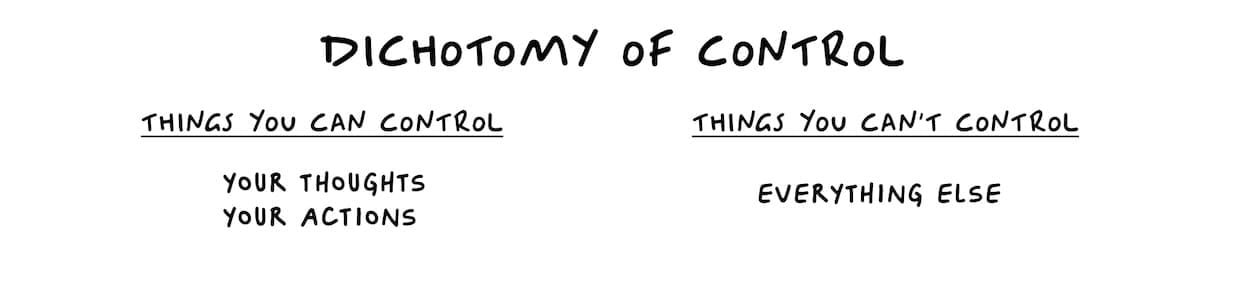
The dichotomy of control, states that 'a large percentage of the things that cause you stress and worry are things that there's jack shit that you can do to control them. I finally realized just how much of my stress came from trying to control things that were simply out of my hands.'
The practice that I've been trying out lately is to sort my commitments into three piles:
- things I want to do.
- things I think I should do.
- things I actually have to do.
What I discovered: Most of the noise lives in that middle pile.
The Illusion of Progress
One thing I've noticed about myself is how easy it is to confuse talking about who I want to be with actually becoming that person. What's more troublesome is how satisfying that can feel. Even when nothing has changed.
A small example: buying a new notebook. I've done this more times than I can count, and it comes with a quiet promise: this will be the notebook that helps me organize my thoughts better.
Of course, nothing about owning the new notebook actually changes my behavior. But the act of buying it is strangely satisfying.
It turns out that this feeling isn't an accident. The notebook is a symbol that impedes real progress. Gollwitzer's Self-Completion Theory: when an identity feels incomplete, symbols can temporarily satisfy the feeling of progress, often enough to delay the real work.
The problem isn't the notebook. It's the way the symbol can temporarily replace the work. When that happens, it doesn't push me forward; it lets me rest in the illusion that I've already moved.
The tricky question then remains - what am I actually giving my attention to? Every new tool or commitment I take on quietly asks for time, energy, and focus.
The more I accumulate, the less room there is for anything to take root.
Clearing the Path
One of the most valuable ideas I keep going back to is the art of subtraction.
Subtraction is beautiful: it creates space, time, clarity.
So much of life in 2025 treats everything like it's on fire. Noise, negative energy, and manufactured urgency crowd out attention, leaving little room to think, wander, or notice what actually matters.
Much of this lives in that middle bucket of things I think I should do. Commitments and inputs that compress attention rather than expand it. They leave no room for wandering off course.
Being available requires limits.
Curiosity needs space to roam.
The question I am left with is this: 'what actually deserves my attention at this point in life? And what doesn't.'
And maybe just as important: what does "enough" look like?
Creating Room
In The Daily Stoic, Ryan Holiday makes an important observation:
Sometimes the fastest way forward isn't more; it's less. You could try to increase your wealth, or you could take a shortcut and just want less.
As we enter 2026, that's the mindset I'm starting the year with.
Not a resolution. Not even a word of the year (last year I already tried going with less and obviously I failed).
This year is about fewer rules and defaults. Clearing the (literal) brush so it's easier to see what's interesting. Find practices that refill energy instead of quietly taking it.
Focus on curiosity - it doesn't need more discipline or false progress. It needs room to move and explore.
Spend more time wondering without needing to justify it.
Fin
2026 isn't about getting somewhere faster. It's about attention and choice. It's about being available.
Available to ideas, to people, to what's interesting, human, and unexpected.
I'll wrap this up with a quote from a 1977 Newsweek interview with Carl Sagan:
Somewhere, something incredible is waiting to be known.
And 2026 is about removing the things that get in the way of curiosity. Having more room to explore what I'm discovering about myself.