Acquiescence

"These walls are funny. First you hate 'em, then you get used to 'em. Enough time passes, you get so you depend on them. That's institutionalized." - Red (Morgan Freeman), The Shawshank Redemption
(Side note: I like emdashes. Too bad if they have a bad rap these days.)
The Diagnosis
Some time back, I wrote about "The Path" and that things can just happen in life or work that lead you to a place, even though you may not be able to see the destination.
It's important to remember while the past is fixed, the future isn't.
The problem with looking back is that the past offers a sense of certainty. This worked. That didn't. There's a status quo bias at work here — a tendency to prefer things stay the way they are, simply because that's the way they already are. That's different from functional fixedness, where you can't see an alternative.
What I'm talking about is that even if there is a better option, it simply does not matter. Most folks just can't let go of the past.
Taken to its logical end, it looks like this: the first guy to bring fire into a cave got a lecture on 'unapproved heat sources' and was asked to submit a request through the Torch Review Board. Approval took two winters. Half the tribe froze, but the process was followed.
Change is inevitable. Nothing ever remains. Even the universe will eventually end, crush itself and turn into emptiness and nothingness. Hopefully it's not this year.
Some of the most dangerous words to any career, company, etc., are 'that's not the way we used to do it.' Contrary to what you will hear at the watercooler, stagnation does not keep you safe — it puts you at risk. If you, your team, or your thinking chooses not to evolve, it will become extinct.
Why It's Worse Than Nostalgia
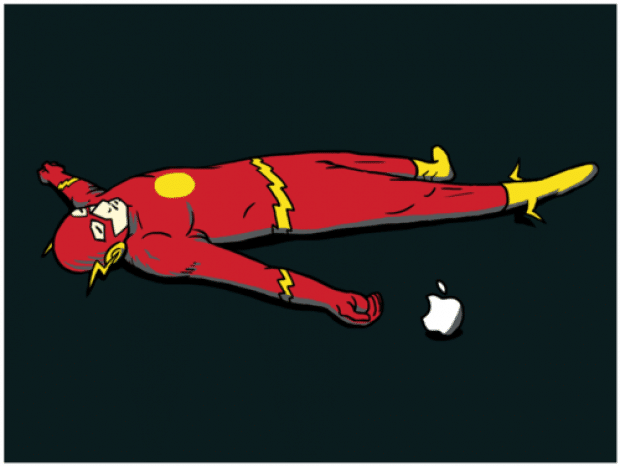
Back in April of 2010, Steve Jobs published his famous open letter entitled "Thoughts on Flash." The post not only criticized Adobe Flash but also outlined the reasons why it wouldn't be allowed on Apple's iOS devices. What I thought was particularly interesting, re-reading the memo 16 years later, was the closing sentence:
"Perhaps Adobe should focus more on creating great HTML5 tools for the future, and less on criticizing Apple for leaving the past behind."
Unsurprisingly, at the time, the letter sparked a bit of outrage. There were scores of highly specialized flash developers in the industry (though, admittedly, even back then, I thought it was weird that someone had the job title of "flash engineer"), and many argued back that Flash wasn't going anywhere. But time would eventually show that Apple was right; people adapted and applied their skills to different areas, especially as the iPhone took off, newer technology (such as HTML5) came along, and those engineers moved forward as they applied their knowledge to new domains.
Flash is now, like most things in tech over any timeline, long since dead. The technology dying was never the cost. The cost was every month spent defending it instead of moving.
The Art of Acquiescence
Sometimes a clean break, a new or opposite perspective, is the only path forward if you want change. The Stoics refer to this as the "art of acquiescence":
The fates guide the person who accepts them and hinders the person who resists them — Cleanthes
Cleanthes is talking about an individual accepting fate; the past, the decision already made, as not yours to keep fighting. But acquiescence doesn't have to be an individual act of letting go. You can build it into the system itself, so nothing has to earn the right to survive by default.
'How States Can Cut Rules and Regulations—and Make It Stick' is a fantastic practical example of how Idaho recently broke the trend when it came to regulatory processes. The state implemented a process called Zero-Based Regulation (ZBR) to reverse long-standing regulatory inertia, forcing agencies to justify why existing rules should remain rather than simply assuming they are necessary.
What's being accepted isn't the rule. It's that the rule has no claim on tomorrow just because it exists today.
Just imagine an organizational budget where, instead of defaulting to 'flat,' you had to start over from zero. Justify why it's needed instead of assuming it's necessary.
Bending Like Bamboo
Look, I'm not saying that it's easy to make a burn-the-ships move like this. It's damn hard to let go of what was when you're surrounded by things rooted in the way things have always been. One method that can help start driving change in environments like this is called the bamboo technique.
The idea is pretty simple: Just as bamboo bends and then snaps back when a strong wind blows, so should you. Acknowledge others' perspectives. If someone says 'this will never work,' you 'bend' like bamboo, respond with 'you might be right, this is going to be challenging', and 'snap back' with actions that they can try next to move slightly forward. It's all about concrete, doable steps.
And celebrate the tiniest signs of progression.
Acquiescence is what you do when you're the one who won't let go.
Bamboo is something you can do when someone else won't.

Here's a version of the bamboo conversation that I've had at several companies. It's a useful example, albeit a bit technical. Cloud costs are always a fun place to dig into as they typically just climb year after year. When I have told finance I can hold it flat, they always tell me it can't be done. So I ask for a few weeks to dig in. No harm. A cloud bill is smoke, not fire — it tells you where to look, and following it may reveal savings. Usually that means starting with the top ten most expensive accounts and looking at what's really costing you. What you'll find — the infrastructure is over-provisioned, has weird excess storage costs, or is literally burning money on machines that aren't really doing anything. Little changes here can yield big results. The savings have always come, not because of a heroic cut, but because someone finally looked.
Close
None of this is really about cloud bills. It's about anything that survives only because nobody has asked it to justify itself: a vendor contract, a legacy system, a process, the job you stayed in because you were already in it, the routine you never questioned, or the story you tell about who you are and what you're supposed to want. The problem isn't that the old way exists.
It's that questioning it takes effort, so the default quietly wins.
That default is the bear. It's ok to poke it, and in some cases it's your responsibility. Clinging to the past is admitting defeat before even trying, and the price of trying is small: a few weeks, no harm, and someone willing to look.
The walls aren't the problem. Never asking why they're there is.
(P.S. There's a name for the version where everyone sees it and no one says it: Hypernormalization. But that's a different post.)